
By Erik Reurts, Mortgage Broker & First Home Buyer Coach, Micah Finance Solutions · Updated October 2026
Quick answer
Yes, HECS-HELP debt affects your home loan, but less than most people think. Lenders don’t look at your balance. They look at your compulsory yearly repayment, which comes out of your take-home pay and reduces how much you can borrow. Since 30 September 2025, HECS no longer counts in the debt-to-income ratio banks report to APRA, and lenders can choose to ignore your repayments if you’ll pay the debt off soon.
$69,528
Income below which you make no compulsory HECS repayment (2026-27)
~$60,000
How much a $506/month HECS repayment can cut borrowing power
30 Sep 2025
HECS removed from the debt-to-income ratio banks report to APRA
I talk to a lot of first home buyers who assume their HECS debt rules them out. It doesn’t. But it does change the numbers, and if you don’t know how, you can’t plan around it. As I always say: you don’t know what you don’t know. So let’s fix that.
How Do Lenders Treat HECS Debt?
HECS isn’t like a credit card or car loan. There’s no fixed monthly repayment. Instead, the ATO takes a percentage of your income above a threshold through the tax system.
That’s exactly how lenders treat it. They don’t care whether you owe $15,000 or $60,000. They work out the compulsory repayment on your income, treat it as money you can’t put towards a mortgage, and reduce your borrowing power accordingly.
How Much Is My Compulsory HECS Repayment in 2026-27?
From 1 July 2025, repayments moved to a marginal system. You only repay on income above the threshold, a bit like income tax brackets.
| Repayment income (2026-27) | Yearly HECS repayment | About per month |
|---|---|---|
| Under $69,528 | $0 | $0 |
| $80,000 | $1,571 | $131 |
| $110,000 | $6,071 | $506 |
| $130,000 | $9,076 | $756 |
| $140,000 | $10,776 | $898 |
Above about $186,000, the system switches to a flat 10% of your total repayment income.
How Much Does HECS Reduce My Borrowing Power?
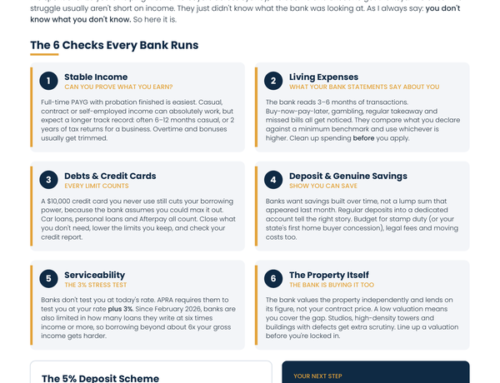
Because banks test your loan at your rate plus 3% (I explain why in What Banks Look For Before Approving Your Home Loan), every dollar of HECS repayment cuts your borrowing power by more than you’d expect.
Take someone on $110,000. Their HECS repayment is about $506 a month. At an assessment rate of around 9%, that $506 a month could reduce their borrowing power by roughly $60,000. Same person, same income, a very different price range.
Erik’s tip
If you’re close to paying HECS off, tell your broker. It can make a big difference to which lender we choose.
What Changed With APRA’s HECS Rules?
Two things changed, both in your favour:
- HECS is out of the debt-to-income ratio. Since 30 September 2025, banks no longer count HELP debt in the debt-to-income figures they report to APRA. That matters even more now that lending at six times your income or more has been capped since 1 February 2026.
- Lenders can ignore your repayments if you’ll pay it off soon. APRA’s updated guidance lets banks exclude HECS repayments from their serviceability calculations where you’re expected to repay the debt in the near term. Many lenders use a 12-month window.
The catch: lenders don’t have to apply the exclusion, and each one sets its own rules. That’s why the lender you choose matters.
Should I Pay Off My HECS Before Buying a Home?
Not always. It’s a trade-off.
| Pay HECS off first | Keep your cash for the deposit |
|---|---|
| Your repayment disappears, so your borrowing power goes up | A bigger deposit can avoid LMI or open up a better property |
| Makes sense if the balance is small and you’re close to finishing | Makes sense if the balance is large and paying it would wipe out your deposit |
| No more indexation on the balance | HECS isn’t charged interest, only indexation |
The right call depends on your balance, your income, your deposit and your target price. Run the numbers both ways before you decide.
Did the 20% HECS Cut Help?
Yes, for your balance. The government cut student debts by 20% in 2025, which brought many people’s payoff date forward. If that now puts you within a year of paying it off, some lenders may exclude your repayments altogether.
It didn’t change the repayment rates, though. Your compulsory repayment is still based on your income.
How to Buy Your First Home With a HECS Debt
- Check your balance in myGov, so you know exactly where you stand.
- Work out your repayment on your current income using the table above.
- Ask whether you’re within 12 months of paying it off. If you are, some lenders may ignore it.
- Compare lenders before you apply. Each one treats HECS differently, and one application is better than three.
- Don’t forget the 5% Deposit Scheme. Having HECS doesn’t stop you buying with 5% down and no LMI, if you’re eligible.
Frequently Asked Questions
Does HECS debt affect my credit score?
No. HECS isn’t reported to credit bureaus, so it doesn’t appear on your credit file. It only affects how much a lender will lend you.
Do lenders look at my HECS balance?
Mostly not. They look at your compulsory repayment, which depends on your income. Your balance matters mainly when a lender decides whether you’ll pay it off soon.
Can I get a home loan if I earn under the HECS threshold?
Yes. If your income is under $69,528, you have no compulsory repayment, so most lenders won’t deduct anything.
Should I use my deposit to pay off my HECS?
Only if the numbers say so. A smaller deposit can mean paying LMI or missing out on the right property. A broker can run both scenarios for you.
Your Next Step: Make HECS Part of the Plan
HECS shouldn’t stop you buying your first home. It just needs to be part of the plan. Book a free 15-minute strategy call with me and we’ll work out what your HECS really means for your borrowing power, and which lenders will treat it best.
Free 15-minute strategy call
Find out where you stand and what to do next, with no obligation.
Call Erik on 0416 179 876
Keep reading
- What Banks Look For Before Approving Your Home Loan
- The First Home Super Saver Scheme: How to Grow Your Deposit Faster
- How to Buy Your First Home: The 8-Step Success Strategy
About the author
Erik Reurts is a mortgage broker and first home buyer coach at Micah Finance Solutions, with over 20 years in finance and property and more than 100 five-star Google reviews. He helps first home buyers in Sydney, Melbourne and Brisbane get finance-ready and into their first home. Erik is an Authorised Credit Representative (ACR 523587) of Mortgage Australia Group Pty Ltd (ACL 377294).
Sources
- ATO: Study and training loan repayment thresholds and rates
- Home Loan Experts: HECS debt excluded from DTI
- Mozo: Home loan approval in 2026 (APRA DTI cap)
- The New Daily: APRA and ASIC HECS changes
Disclaimer: This article is general information only and doesn’t take your personal circumstances into account. Erik Reurts – MFS – ACR 523587





Leave A Comment