
By Erik Reurts, Mortgage Broker & First Home Buyer Coach, Micah Finance Solutions · Updated October 2026
Quick answer
Before approving a home loan, Australian banks check six things: stable income, living expenses, existing debts and credit limits, genuine savings and deposit, serviceability (whether you can repay at your rate plus 3%), and the property itself. First home buyers in Sydney, Melbourne and Brisbane who prepare for these checks 3 to 6 months before applying have the best chance of approval.
Getting your home loan approved isn’t luck. Banks run every first home buyer through the same six checks, and once you know what they are, you can prepare for them months before you apply.
I’ve spent over 20 years helping first home buyers across Sydney, Melbourne and Brisbane get the keys. The ones who struggle usually aren’t short on income. They just didn’t know what the bank was looking at. As I always say: you don’t know what you don’t know. So here it is.
The 6 Checks at a Glance
| Check | What the bank looks at | What you can do |
|---|---|---|
| 1. Income | Stable, verifiable income and how long you’ve earned it | Finish probation; keep 2 years of tax returns if self-employed |
| 2. Living expenses | 3 to 6 months of bank statements | Cut BNPL, gambling and takeaway 3 to 6 months out |
| 3. Debts | Every loan and credit card limit | Close unused cards, lower limits, check your credit report |
| 4. Deposit | Savings built over time (genuine savings) | Save regularly into one dedicated account |
| 5. Serviceability | Repayments at your rate plus 3% | Know your borrowing power before you shop |
| 6. Property | The bank’s own valuation | Get a valuation before you’re locked in |
1. Stable Income: How Do Banks Check Your Income?
Banks and lenders want income that’s reliable and can be verified. Full-time PAYG with probation finished is the easiest. Casual, contract or self-employed income can absolutely work, but expect to show a longer track record: often 6 to 12 months of casual income, or 2 years of tax returns if you run a business. Overtime and bonuses usually get trimmed, so don’t count on every dollar.
2. Living Expenses: What Do Banks Look For in Your Bank Statements?
The bank looks at your household (your partner, kids and any other dependants) and reads 3 to 6 months of your transaction history. Buy-now-pay-later, dining out, gambling, regular takeaway and missed bills all get noticed. They compare the expenses you declare against a minimum benchmark for a household like yours and use whichever is higher.
Tip: clean up your spending 3 to 6 months before you apply, not after.
3. Debts and Credit Cards: Does an Unused Credit Card Affect Your Borrowing Power?
Yes. A $10,000 credit card you never use still reduces your borrowing power, because the bank sees it as a loan you can max out any time you like. Car loans, personal loans and Afterpay accounts all count too. Close what you don’t need, lower the limits on what you keep, and check your credit report for surprises.
4. Deposit and Genuine Savings: Show the Bank You Can Save
Banks like to see savings built up over time, not a lump sum that appeared last month. Regular deposits into a dedicated account tell the story you want: this person can handle a mortgage and is responsible with their money.
Remember to budget for stamp duty (or the first home buyer concession in your state), legal fees and moving costs on top of your deposit.
5. Serviceability: What Is the 3% Serviceability Buffer?
This is the one that catches people out. Banks don’t test whether you can afford today’s rate. APRA, the banking regulator, requires them to test you at your rate plus 3%. On a 6% loan, the bank checks whether you could still pay at 9%.
And since 1 February 2026, banks are limited in how many loans they can write where total debt is six times your income or more. In practice, borrowing more than about 6x your gross income gets harder. Use a mortgage repayment calculator to see what your repayments look like, then have a broker check your actual borrowing power.
6. The Property: What Happens If the Bank Valuation Comes In Low?
The bank values the property independently and lends against its figure, not your contract price. If the valuation comes in low, you’ll need to cover the gap from your own funds. Some properties get extra scrutiny: small studio apartments, high-density towers, and units in buildings with defects. Always get a valuation lined up before you’re locked in.
Can You Buy With a 5% Deposit in Sydney, Melbourne or Brisbane?
Yes. You may not need 20%. Under the Australian Government 5% Deposit Scheme, eligible first home buyers can buy with a 5% deposit and pay no lenders mortgage insurance. Since October 2025 there are no income caps and no limit on places. You still have to pass all six checks above.
| City | 5% Deposit Scheme price cap |
|---|---|
| Sydney | $1,500,000 |
| Brisbane | $1,000,000 |
| Melbourne | $950,000 |
Both the purchase price and the lender’s valuation must be at or below the cap. Caps are set by location, so check your postcode on the official First Home Buyers site before you start looking.
How to Prepare for Home Loan Approval: A 6-Month Checklist
- 6 months out: stop buy-now-pay-later and gambling transactions, and start saving the same amount into one dedicated account each pay.
- 4 months out: close credit cards you don’t use and lower the limits on the ones you keep.
- 3 months out: order your free credit report and fix any errors.
- 2 months out: gather payslips, tax returns and statements, and get your borrowing power checked.
- 1 month out: get pre-approval from the right lender, then start making offers.
Frequently Asked Questions
How much can I borrow for my first home?
It depends on your income, living expenses and existing debts. Banks test your repayments at your interest rate plus 3%, and since 1 February 2026 lending above six times your gross income is harder to get. As a rough guide, about 6x your gross household income is the practical ceiling for most first home buyers.
Do I need a 20% deposit to buy my first home?
No. Under the Australian Government 5% Deposit Scheme, eligible first home buyers can buy with a 5% deposit and pay no lenders mortgage insurance, as long as the property is under the price cap for its location ($1.5 million in Sydney, $1 million in Brisbane and $950,000 in Melbourne).
Does Afterpay or buy-now-pay-later affect my home loan application?
Yes. Banks treat buy-now-pay-later accounts as debts and will see the transactions in your bank statements. Closing accounts you don’t need, a few months before you apply, makes your application cleaner.
Can I get a home loan if I’m casual or self-employed?
Yes. Lenders usually want a longer track record: often 6 to 12 months of casual income, or 2 years of tax returns if you run your own business. Some lenders are more flexible than others, which is where choosing the right lender matters.
Does an unused credit card reduce my borrowing power?
Yes. Banks assess the full credit card limit as if you could max it out, even if the balance is zero. Reducing the limit, or closing cards you don’t use, can increase how much you can borrow.
Does applying with several banks hurt my credit score?
Each home loan application is recorded as an enquiry on your credit file, and several applications in a short time can look like you’ve been declined elsewhere. It’s better to prepare first, choose the right lender, and apply once.
Your Next Step: Get Ready Before You Apply
Every bank weighs these checks differently. One might say no where another says yes, and a declined application leaves a mark on your credit file. That’s why the order matters: get prepared, then pick the right lender, then apply once.
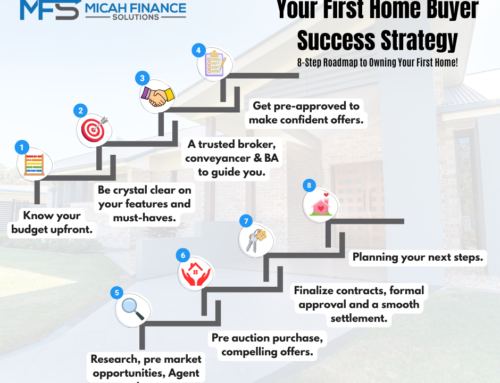
Book a free 15-minute strategy call with me. We’ll look at where you stand on each of the six checks and map out exactly what to fix before you apply. Want the full roadmap first? Download my 8-Step First Home Buyer Success Strategy.
About the author
Erik Reurts is a mortgage broker and first home buyer coach at Micah Finance Solutions, with over 20 years in finance and property and more than 100 five-star Google reviews. He helps first home buyers in Sydney, Melbourne and Brisbane get finance-ready and into their first home. Erik is an Authorised Credit Representative (ACR 523587) of Mortgage Australia Group Pty Ltd (ACL 377294).
Sources
- 6 Things the banks look at -2026- report
- First Home Buyers: 5% Deposit Scheme property price caps
- Housing Australia: Expanded 5% Deposit Scheme
- APRA: Activation of debt-to-income limits
General information only. It doesn’t consider your objectives, financial situation or needs. Lending criteria, scheme rules and price caps can change.


Leave A Comment