
By Erik Reurts, FHB Mortgage Specialist & First Home Buyer Coach, Micah Finance Solutions · Updated October 2026
Quick answer
Buying your first home in Australia comes down to eight steps in three phases. Prepare: know your borrowing power, define your target property, select your team and get pre-approval. Find: run a focused property search and secure the property with the right offer. Settle: get formal approval, settle and collect your keys, then set up your loan properly. With the 5% Deposit Scheme, many first home buyers in Sydney, Melbourne and Brisbane can start with a 2% to 5% deposit.
Most first home buyers I meet aren’t short on motivation. They’re short on a plan. They scroll listings for months, go to open homes that don’t fit, talk to agents who never call back, and feel more overwhelmed every weekend.
After more than 20 years in finance and property, I’ve seen the same pattern over and over: the buyers who get the keys fastest follow a clear sequence. They sort out their finance first, know exactly what they’re looking for, and have the right people in their corner before they make an offer. This is that sequence, the 8-step First Home Buyer Success Strategy I walk my clients through.
The 8 Steps at a Glance
PHASE 1 · PREPARE
- 1. Know your borrowing power
- 2. Define your target
- 3. Select your team
- 4. Get finance ready
PHASE 2 · FIND
- 5. Property research strategy
- 6. Securing the property
PHASE 3 · SETTLE
- 7. Approval, settlement & keys
- 8. Post settlement
| Step | What you do | What you walk away with |
|---|---|---|
| 1. Borrowing power | Work out what you can borrow, from which lenders, and your deposit options | A realistic price range |
| 2. Define your target | Set your suburbs, property type, must-haves and deal-breakers | A one-page property brief |
| 3. Select your team | Line up a broker, conveyancer and building inspector | Your A-Team, ready to move |
| 4. Finance ready | Apply for pre-approval with the right lender | Confidence to offer or bid |
| 5. Research strategy | Run a focused search and check comparable sales | A shortlist of the right homes |
| 6. Secure the property | Negotiate and structure your offer | A signed contract |
| 7. Approval & settlement | Valuation, formal approval, contract checks, settlement | Your keys |
| 8. Post settlement | Set up your offset, repayments and a yearly review | A loan that keeps working for you |
Phase 1 · Prepare
Step 1: Know Your Borrowing Power
Before you look at a single listing, you need real clarity on what you can borrow, and from whom. This isn’t just about the biggest number a bank will give you. It’s about a loan and a strategy that fit your lifestyle, your goals and your long-term plans.
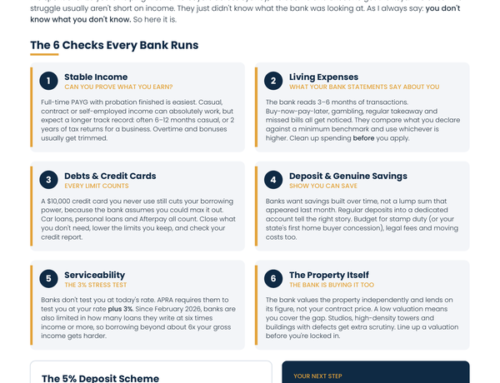
What decides how much you can borrow?
- Your income, and how stable and provable it is.
- Your living expenses, taken from 3 to 6 months of bank statements.
- Your debts and credit limits, including credit cards you never use and buy-now-pay-later accounts.
- The 3% serviceability buffer: banks test whether you could still pay if your rate were 3% higher.
- The debt-to-income limit: since 1 February 2026, lending at six times your income or more is harder to get.
I cover each of these in detail in What Banks Look For Before Approving Your Home Loan.
How much deposit do you need?
Many buyers I work with get in with as little as a 2% to 5% deposit. Under the Australian Government 5% Deposit Scheme, eligible first home buyers can buy with 5% down, or 2% for single parents and legal guardians, and pay no lenders mortgage insurance (LMI). Since October 2025 there’s no income cap and no limit on places.
Here’s what that looks like on an $800,000 home:
| Option | Deposit needed | Lenders mortgage insurance |
|---|---|---|
| Traditional 20% deposit | $160,000 | No |
| 5% Deposit Scheme | $40,000 | No (government guarantee) |
| 5% deposit without the scheme | $40,000 | Yes, often tens of thousands of dollars |
| Single parent or guardian (2%) | $16,000 | No (government guarantee) |
The property must be at or below the price cap for its location, and both the purchase price and the bank’s valuation have to fit under it:
| City | 5% Deposit Scheme price cap |
|---|---|
| Sydney | $1,500,000 |
| Brisbane | $1,000,000 |
| Melbourne | $950,000 |
Don’t forget stamp duty and upfront costs
Stamp duty (transfer duty) can be one of the biggest upfront costs, but first home buyers often pay little or none:
| State | No stamp duty up to | Reduced stamp duty up to |
|---|---|---|
| NSW | $800,000 (new or existing home) | $1,000,000 |
| Victoria | $600,000 | $750,000 |
| Queensland | $700,000 (established home); no cap for brand-new homes (contracts from 1 May 2025) | $800,000 (established home) |
On top of your deposit, budget for conveyancing, a building and pest inspection, loan fees, insurance and moving costs.
Erik’s tip
Get your borrowing power checked by a broker before you fall in love with a property. Online calculators give you a ballpark, but every lender assesses income, expenses and debts differently, and the difference between lenders can be tens of thousands of dollars.
Step 2: Define Your Target Property
This is where many first home buyers get stuck: scrolling through endless listings, visiting homes that don’t fit, talking to agents but not hearing back, and feeling overwhelmed by too many options.
To succeed in a competitive market, you need to be crystal clear on your property specifics: the features you want, the suburbs and streets, the orientation, your nice-to-haves and your non-negotiables. Write it down. It becomes your filter for every listing, every inspection and every conversation with an agent.
| Must-haves | Nice-to-haves | Deal-breakers |
|---|---|---|
| 2+ bedrooms | North-facing living area | Major building defects |
| Under 45 minutes to work | Second bathroom | High-density tower (harder to finance) |
| Within the 5% Deposit Scheme cap | Courtyard or balcony | Studio under 40m² (many banks won’t lend) |
| Off-street parking | Walk to train or shops | Flood zone or main road noise |
These are examples only. Your own brief should reflect your budget, lifestyle and plans for the next 5 to 10 years.
Step 3: Select Your Team
Buying your first home isn’t a solo mission. You need the right people in your corner, your A-Team, to guide you through the tricky parts like lender policy and sales contracts, protect you from costly mistakes, and give you confidence every step of the way. Line them up before you find a property, so you can move fast when you do.
| Who | What they do for you | When you need them |
|---|---|---|
| Mortgage broker | Compares lenders, structures your loan, handles pre-approval through to settlement | First, before you start looking |
| Conveyancer or solicitor | Reviews the contract, handles legal transfer and settlement | Before you make an offer or bid |
| Building & pest inspector | Finds structural problems, termites and defects | Before you’re committed to buy |
| Strata report (units and townhouses) | Checks the building’s finances, levies and known defects | Before you’re committed to buy |
| Buyer’s agent (optional) | Searches, negotiates and bids for you | If you’re short on time or buying in a hot market |
Step 4: Get Finance Ready (Pre-Approval)
Pre-approval is the confirmation from a lender that you’re good to go, up to a set amount. It’s the piece of paper that gives you the confidence to make offers or bid at auction, and it tells agents you’re a serious buyer.
Documents you’ll usually need
- Photo ID (driver’s licence and passport)
- Your two most recent payslips, or 2 years of tax returns if you’re self-employed
- 3 to 6 months of bank statements for all accounts
- Statements for credit cards, car loans, HECS and any buy-now-pay-later accounts
- Evidence of your savings and deposit
Most pre-approvals last around 3 to 6 months. Keep your finances steady while it’s active: no new car loans, no new credit cards and no big unexplained spending.
Phase 2 · Find
Step 5: Build Your Property Research Strategy
This is the exciting part: actually searching for properties. But here’s the trap. If you rely on scrolling through listings at random, you’ll feel like you’re drowning in options.
A successful first home buyer plan has a well-defined search. Using your brief from Step 2, you’ll know exactly what to look for and what to ask agents. That clarity saves you weekends and helps you spot the right home quickly.
- Set saved searches on the property portals using your exact suburbs, price range and must-haves.
- Check comparable sales of similar homes sold in the last 3 to 6 months, so you know what a property is really worth.
- Track days on market. Homes that have sat for a while often leave more room to negotiate.
- Inspect with a checklist so every property is judged against the same brief.
- Build relationships with local agents, and tell them you’re pre-approved and ready.
Step 6: Secure the Property
Once you’ve found the right home, how you negotiate matters as much as what you offer. Securing a property like a pro means knowing what to ask the agent, what not to tell them, and how to structure your offer, especially if you want to lock it in before auction.
| Ask the agent | Keep to yourself |
|---|---|
| What price range is the seller expecting? | Your maximum budget |
| Why is the owner selling, and how soon? | That you’ve fallen in love with the place |
| Have there been any offers yet? | How much your pre-approval is for |
| Will the seller consider a pre-auction offer? | That you’ve missed out on other homes |
| Are building, pest or strata reports available? | Your deadline to buy |
Private sale or auction?
With a private sale you can usually make your offer subject to finance and a building and pest inspection, and you get a cooling-off period. At auction there’s no cooling-off and no conditions, so your finance, inspections and contract review must be done before you bid.
| State | Cooling-off period (private sale) | Cost to pull out |
|---|---|---|
| NSW | 5 business days (10 for off-the-plan) | 0.25% of the price |
| Victoria | 3 business days | 0.2% of the price or $100, whichever is more |
| Queensland | 5 business days | Up to 0.25% of the price |
There’s no cooling-off period at auction in any of these states.
Erik’s tip
A strong pre-auction offer can take a property off the market before the competition shows up. It only works if your pre-approval, deposit and contract review are already done, so get those sorted in Phase 1.
Phase 3 · Settle
Step 7: Approval, Settlement & Keys
You’ve done the hard work of getting pre-approved and finding and securing a property. Now it’s time for your team to do their magic: making sure the contract is watertight and getting your formal, unconditional approval.
| Pre-approval | Formal (unconditional) approval | |
|---|---|---|
| When | Before you find a property | After you’ve signed a contract |
| Based on | Your income, expenses and debts | Your finances plus the bank’s valuation of the property |
| Is the money confirmed? | No, it’s conditional | Yes |
What happens between contract and keys
- The bank orders a valuation of the property.
- Your broker submits the contract and any final documents for formal approval.
- Your conveyancer reviews the contract, searches and special conditions.
- You sign your loan documents and arrange building insurance as required.
- You do a pre-settlement inspection.
- Settlement: the bank pays the seller, the title transfers, and you get the keys.
Step 8: Post Settlement
This step might not seem important, but most first home buyers still have questions after they move in. How does my offset account work? When is my first payment due? What happens when rates change? My job doesn’t end at settlement. I make sure your questions get answered and your loan keeps working for you.
- Your first repayment is usually due about a month after settlement. Your loan documents show the date.
- An offset account reduces the interest you pay. With $20,000 in offset against a $600,000 loan, you’re charged interest on $580,000.
- Review your rate every year. Lenders often offer new customers better rates than existing ones, so a yearly check-in can save you thousands.
Common First Home Buyer Mistakes (and What to Do Instead)
| Mistake | Why it hurts | Do this instead |
|---|---|---|
| House-hunting before pre-approval | You can’t act fast when the right home comes up | Get pre-approved first (Step 4) |
| Applying with several banks at once | Multiple credit enquiries can look like rejections | Let a broker pick the right lender, then apply once |
| Telling the agent your maximum budget | You’ll likely pay it | Share that you’re pre-approved, not how much for |
| Skipping building and pest inspections | Hidden defects can cost tens of thousands | Inspect before you commit |
| Taking on new debt before settlement | Your formal approval can fall over | Keep your finances steady until you have the keys |
Frequently Asked Questions
What are the steps to buying your first home in Australia?
The eight steps are: 1) know your borrowing power, 2) define your target property, 3) select your team, 4) get finance ready with a pre-approval, 5) build a property research strategy, 6) secure the property, 7) get formal approval and settle, and 8) set up your loan properly after settlement.
How much deposit do I need to buy my first home?
Under the Australian Government 5% Deposit Scheme, eligible first home buyers can buy with a 5% deposit, or 2% for single parents and legal guardians, without paying lenders mortgage insurance. The property must be under the price cap for its location: $1.5 million in Sydney, $1 million in Brisbane and $950,000 in Melbourne.
How long is a home loan pre-approval valid?
Most pre-approvals are valid for around 3 to 6 months, depending on the lender. If yours expires before you buy, it can usually be renewed, but the lender will reassess your income, expenses and debts.
What is the cooling-off period when buying a home in NSW, Victoria and Queensland?
NSW has a 5 business day cooling-off period (10 for off-the-plan), Victoria has 3 business days and Queensland has 5 business days. There is no cooling-off period when you buy at auction, and you’ll usually lose a small part of the price (around 0.2% to 0.25%) if you pull out during cooling-off.
Do first home buyers pay stamp duty?
Often not, or much less. In NSW there’s no transfer duty on homes up to $800,000. In Victoria there’s no duty up to $600,000. In Queensland there’s no duty on established homes up to $700,000, and no duty at all on brand-new homes for contracts signed from 1 May 2025. Above those amounts, concessions may still reduce what you pay.
Can I make an offer before an auction?
Yes. Many agents will take a pre-auction offer if it’s strong enough for the seller to cancel the auction. You’ll need your pre-approval in place, your deposit ready and your contract already reviewed, because pre-auction offers are often unconditional.
What’s the difference between pre-approval and formal approval?
Pre-approval is the lender’s conditional yes based on your finances, before you’ve found a property. Formal (unconditional) approval comes after you’ve signed a contract, the bank has valued the property and all conditions are met. Only formal approval means the money is confirmed.
When is my first mortgage repayment due after settlement?
Usually about a month after settlement, depending on your lender and whether you chose weekly, fortnightly or monthly repayments. Your loan documents will show the first due date.
Your Next Step: Book Your Free Home Buyer Action Plan
Every buyer starts in a different spot. Some need to work on their deposit, some need the right lender, and some are ready to make offers next month. The fastest way to find out where you are is a quick chat.
Free 15-minute phone call
Book your free Home Buyer Action Plan. In 15 minutes we’ll work out which step you’re up to, what your borrowing power looks like, and what to do next.
Call Erik on 0416 179 876
About the author
Erik Reurts is a first home buyer mortgage specialist and coach at Micah Finance Solutions. He started as a property investor in 2000 and has spent over 20 years in finance and property, with more than 100 five-star Google reviews from clients. He created the 8-Step First Home Buyer Success Strategy to help buyers in Sydney, Melbourne and Brisbane get from confused to keys. Erik is an Authorised Credit Representative (ACR 523587) of Mortgage Australia Group Pty Ltd (ACL 377294).
Sources
- Our 8 Step First Home Strategy
- First Home Buyers: 5% Deposit Scheme property price caps
- First Home Buyers: FAQ (2% deposit for single parents and guardians)
- APRA: Activation of debt-to-income limits
- Revenue NSW: First Home Buyers Assistance Scheme
- State Revenue Office Victoria: First home buyer duty exemption or concession
- Queensland Revenue Office: First home concession
- Queensland Revenue Office: First home (new home) concession
- NSW Government: Contracts and deposits (cooling-off)
- Queensland Government: Cooling-off period for residential properties
General information only. It doesn’t consider your objectives, financial situation or needs. Scheme rules, stamp duty thresholds, cooling-off rules and lending criteria can change; check current details before you act.





Leave A Comment